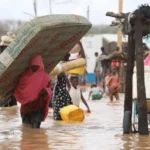

With homes, roads, businesses and critical infrastructure repeatedly threatened by floodwaters, the Nigeria Hydrological Services Agency (NIHSA) has warned that the flood situation could persist through September, with August and September expected to remain particularly challenging.
The warning comes as Lagos continues to grapple with the consequences of rapid urbanisation, intense rainfall, rising water levels and poor waste disposal, particularly the indiscriminate dumping of plastics and other refuse into drains and waterways.
NIHSA Director-General, Umar Mohammed, recently warned that flooding could continue intermittently until September, saying the agency expected the situation to worsen around August and September if urgent preventive measures were not taken.
Lagos, he said, remains particularly vulnerable because of its exposure to urban, riverine and coastal flooding. Blocked drainage channels, siltation, low-lying terrain and rising water levels can compound the effects of heavy rainfall.
Lagos among states at high flood risk
The warning is consistent with NIHSA’s 2026 Annual Flood Outlook, which places Lagos among 33 states and the Federal Capital Territory identified as high-risk areas for flooding.
Nationwide, the outlook identified 14,118 communities across 266 Local Government Areas in 33 states and the FCT as being at high risk of flooding.
Another 15,597 communities across 405 LGAs in 35 states were classified as being at moderate risk, while 923 communities across 77 LGAs in 24 states were projected to experience minimal flooding.
Taken together, the three categories represent more than 30,600 communities facing varying degrees of flood risk during the 2026 rainy season.
We can save Lagos drains — crafts community insists
For residents of Lagos, the rainy season has become a period of anxiety.
With homes, roads, businesses and critical infrastructure repeatedly threatened by floodwaters, the Nigeria Hydrological Services Agency (NIHSA) has warned that the flood situation could persist through September, with August and September expected to remain particularly challenging.
The warning comes as Lagos continues to grapple with the consequences of rapid urbanisation, intense rainfall, rising water levels and poor waste disposal, particularly the indiscriminate dumping of plastics and other refuse into drains and waterways.
NIHSA Director-General, Umar Mohammed, recently warned that flooding could continue intermittently until September, saying the agency expected the situation to worsen around August and September if urgent preventive measures were not taken.
Lagos, he said, remains particularly vulnerable because of its exposure to urban, riverine and coastal flooding. Blocked drainage channels, siltation, low-lying terrain and rising water levels can compound the effects of heavy rainfall.
Lagos among states at high flood risk
The warning is consistent with NIHSA’s 2026 Annual Flood Outlook, which places Lagos among 33 states and the Federal Capital Territory identified as high-risk areas for flooding.
Nationwide, the outlook identified 14,118 communities across 266 Local Government Areas in 33 states and the FCT as being at high risk of flooding.
Another 15,597 communities across 405 LGAs in 35 states were classified as being at moderate risk, while 923 communities across 77 LGAs in 24 states were projected to experience minimal flooding.
Taken together, the three categories represent more than 30,600 communities facing varying degrees of flood risk during the 2026 rainy season.
The outlook also identifies major urban centres, including Lagos, as particularly susceptible to flash and urban flooding because of intense rainfall, rapid urbanisation and inadequate or overwhelmed drainage systems.
The national scale of the warning is considerable. Reports on the 2026 outlook indicate that 4,792 healthcare facilities and 10,684 schools and educational facilities are also exposed to flood risk, while about 4.2 million hectares of farmland could be affected during the year. The July-to-September period is identified as the peak risk window for many of the vulnerable assets.
NIHSA’s own flood forecasting system now provides real-time monitoring, with forecasts updated daily and sensor information updated every 15 minutes. The agency says its system draws on rainfall models, hydrodynamic simulations, satellite observations and ground-based weather stations.
Plastic waste: Lagos’ second flood problem
But behind the statistics lies another problem that is largely man-made: waste.
Lagos generates an estimated 13,000 tonnes of solid waste daily, with plastics constituting a significant proportion. Plastic and nylon waste frequently find their way into gutters, canals and drainage channels, reducing the capacity of the city’s drainage infrastructure to move stormwater.
The consequences can be devastating.
As rainfall increases, blocked channels prevent water from flowing freely, turning ordinary downpours into flash-flood events capable of cutting off roads, inundating homes and businesses and disrupting economic activity.
The problem is not unique to Lagos. Coastal and rapidly urbanising cities around the world are confronting the combined pressures of population growth, extreme rainfall, inadequate drainage and plastic pollution.
We can save Lagos drains — crafts community insists
For residents of Lagos, the rainy season has become a period of anxiety.
With homes, roads, businesses and critical infrastructure repeatedly threatened by floodwaters, the Nigeria Hydrological Services Agency (NIHSA) has warned that the flood situation could persist through September, with August and September expected to remain particularly challenging.
The warning comes as Lagos continues to grapple with the consequences of rapid urbanisation, intense rainfall, rising water levels and poor waste disposal, particularly the indiscriminate dumping of plastics and other refuse into drains and waterways.
NIHSA Director-General, Umar Mohammed, recently warned that flooding could continue intermittently until September, saying the agency expected the situation to worsen around August and September if urgent preventive measures were not taken.
Lagos, he said, remains particularly vulnerable because of its exposure to urban, riverine and coastal flooding. Blocked drainage channels, siltation, low-lying terrain and rising water levels can compound the effects of heavy rainfall.
Lagos among states at high flood risk
The warning is consistent with NIHSA’s 2026 Annual Flood Outlook, which places Lagos among 33 states and the Federal Capital Territory identified as high-risk areas for flooding.
Nationwide, the outlook identified 14,118 communities across 266 Local Government Areas in 33 states and the FCT as being at high risk of flooding.
Another 15,597 communities across 405 LGAs in 35 states were classified as being at moderate risk, while 923 communities across 77 LGAs in 24 states were projected to experience minimal flooding.
Taken together, the three categories represent more than 30,600 communities facing varying degrees of flood risk during the 2026 rainy season.
The outlook also identifies major urban centres, including Lagos, as particularly susceptible to flash and urban flooding because of intense rainfall, rapid urbanisation and inadequate or overwhelmed drainage systems.
The national scale of the warning is considerable. Reports on the 2026 outlook indicate that 4,792 healthcare facilities and 10,684 schools and educational facilities are also exposed to flood risk, while about 4.2 million hectares of farmland could be affected during the year. The July-to-September period is identified as the peak risk window for many of the vulnerable assets.
NIHSA’s own flood forecasting system now provides real-time monitoring, with forecasts updated daily and sensor information updated every 15 minutes. The agency says its system draws on rainfall models, hydrodynamic simulations, satellite observations and ground-based weather stations.
Plastic waste: Lagos’ second flood problem
But behind the statistics lies another problem that is largely man-made: waste.
Lagos generates an estimated 13,000 tonnes of solid waste daily, with plastics constituting a significant proportion. Plastic and nylon waste frequently find their way into gutters, canals and drainage channels, reducing the capacity of the city’s drainage infrastructure to move stormwater.
The consequences can be devastating.
As rainfall increases, blocked channels prevent water from flowing freely, turning ordinary downpours into flash-flood events capable of cutting off roads, inundating homes and businesses and disrupting economic activity.
The problem is not unique to Lagos. Coastal and rapidly urbanising cities around the world are confronting the combined pressures of population growth, extreme rainfall, inadequate drainage and plastic pollution.
For Lagos, however, the problem has become particularly urgent because the city combines a low-lying coastal geography with intense urban development and a huge daily waste stream.
For lawmakers, cause for serious concern
Chairman of the Environment Committee of the Lagos State House of Assembly, Hon. Rasheed Adebola Adekola Shabi, said greater collaboration between government and research institutions was needed to tackle the problem.
Shabi, an environmentalist and former official of the Lagos State Environmental Protection Agency (LASEPA), told Vanguard that universities could play a greater role in turning waste into economically useful products.
“As far back as 2014, we had started doing away with PET bottles but we never had any support then. All these projects, if the university authorities could liaise with government, this country would have gone far.”
We can save Lagos drains — crafts community insists
For residents of Lagos, the rainy season has become a period of anxiety.
With homes, roads, businesses and critical infrastructure repeatedly threatened by floodwaters, the Nigeria Hydrological Services Agency (NIHSA) has warned that the flood situation could persist through September, with August and September expected to remain particularly challenging.
The warning comes as Lagos continues to grapple with the consequences of rapid urbanisation, intense rainfall, rising water levels and poor waste disposal, particularly the indiscriminate dumping of plastics and other refuse into drains and waterways.
NIHSA Director-General, Umar Mohammed, recently warned that flooding could continue intermittently until September, saying the agency expected the situation to worsen around August and September if urgent preventive measures were not taken.
Lagos, he said, remains particularly vulnerable because of its exposure to urban, riverine and coastal flooding. Blocked drainage channels, siltation, low-lying terrain and rising water levels can compound the effects of heavy rainfall.
Lagos among states at high flood risk
The warning is consistent with NIHSA’s 2026 Annual Flood Outlook, which places Lagos among 33 states and the Federal Capital Territory identified as high-risk areas for flooding.
Nationwide, the outlook identified 14,118 communities across 266 Local Government Areas in 33 states and the FCT as being at high risk of flooding.
Another 15,597 communities across 405 LGAs in 35 states were classified as being at moderate risk, while 923 communities across 77 LGAs in 24 states were projected to experience minimal flooding.
Taken together, the three categories represent more than 30,600 communities facing varying degrees of flood risk during the 2026 rainy season.
The outlook also identifies major urban centres, including Lagos, as particularly susceptible to flash and urban flooding because of intense rainfall, rapid urbanisation and inadequate or overwhelmed drainage systems.
The national scale of the warning is considerable. Reports on the 2026 outlook indicate that 4,792 healthcare facilities and 10,684 schools and educational facilities are also exposed to flood risk, while about 4.2 million hectares of farmland could be affected during the year. The July-to-September period is identified as the peak risk window for many of the vulnerable assets.
NIHSA’s own flood forecasting system now provides real-time monitoring, with forecasts updated daily and sensor information updated every 15 minutes. The agency says its system draws on rainfall models, hydrodynamic simulations, satellite observations and ground-based weather stations.
Plastic waste: Lagos’ second flood problem
But behind the statistics lies another problem that is largely man-made: waste.
Lagos generates an estimated 13,000 tonnes of solid waste daily, with plastics constituting a significant proportion. Plastic and nylon waste frequently find their way into gutters, canals and drainage channels, reducing the capacity of the city’s drainage infrastructure to move stormwater.
The consequences can be devastating.
As rainfall increases, blocked channels prevent water from flowing freely, turning ordinary downpours into flash-flood events capable of cutting off roads, inundating homes and businesses and disrupting economic activity.
The problem is not unique to Lagos. Coastal and rapidly urbanising cities around the world are confronting the combined pressures of population growth, extreme rainfall, inadequate drainage and plastic pollution.
For Lagos, however, the problem has become particularly urgent because the city combines a low-lying coastal geography with intense urban development and a huge daily waste stream.
For lawmakers, cause for serious concern
Chairman of the Environment Committee of the Lagos State House of Assembly, Hon. Rasheed Adebola Adekola Shabi, said greater collaboration between government and research institutions was needed to tackle the problem.
Shabi, an environmentalist and former official of the Lagos State Environmental Protection Agency (LASEPA), told Vanguard that universities could play a greater role in turning waste into economically useful products.
«“As far back as 2014, we had started doing away with PET bottles but we never had any support then. All these projects, if the university authorities could liaise with government, this country would have gone far.”»
He pointed to research into converting plastic waste into construction materials and other products, arguing that Nigeria was yet to fully exploit the economic potential of its waste stream.
He also recalled his experience in Singapore, where, he said, technologies existed for extracting useful products from waste.
According to him, the problem is not simply the availability of government programmes but enforcement and public participation.
“When they clean out the drainage in rainy season, most of the blockage is from plastic waste,” he said.
“It’s about enforcement. Does government have to tell you before you clean your frontage? Government is doing its best to ensure we have a cleaner environment. Are we, the people, collaborating?”
Shabi also raised concerns about population growth and the pressure it places on Lagos’ infrastructure.
He said the state receives hundreds of thousands of new residents, while only a fraction leave, placing additional pressure on waste management, housing, transportation and drainage systems.
He also disclosed that he was working on legislation to address indiscriminate disposal of waste, including cases where residents transport waste only to dump it illegally elsewhere.
LASEPA doubles down on nylon bag ban
Against this backdrop, Lagos is tightening its restrictions on single-use plastics.
The Lagos State Environmental Protection Agency has reaffirmed the state’s ban on several single-use plastic products, including disposable cups, Styrofoam food packs, nylon carrier bags and plastic straws.
The restrictions followed the expiration of a six-month transition period granted to residents and businesses to move towards environmentally friendly alternatives.
The Lagos State Ministry of Environment has also listed nylon carrier bags below 40 microns among the prohibited single-use plastics.
The policy reflects a growing recognition that recycling alone cannot solve the city’s plastic problem.
Thin plastic films and nylon shopping bags are particularly difficult to recycle because their lightweight and flexible nature makes them prone to becoming entangled in conventional recycling machinery.
more on Vanguard